A comprehensive guide to explosion-proof and flameproof lighting types, ATEX/IECEx zone classifications, temperature classes, and luminaire selection for hazardous industrial environments.
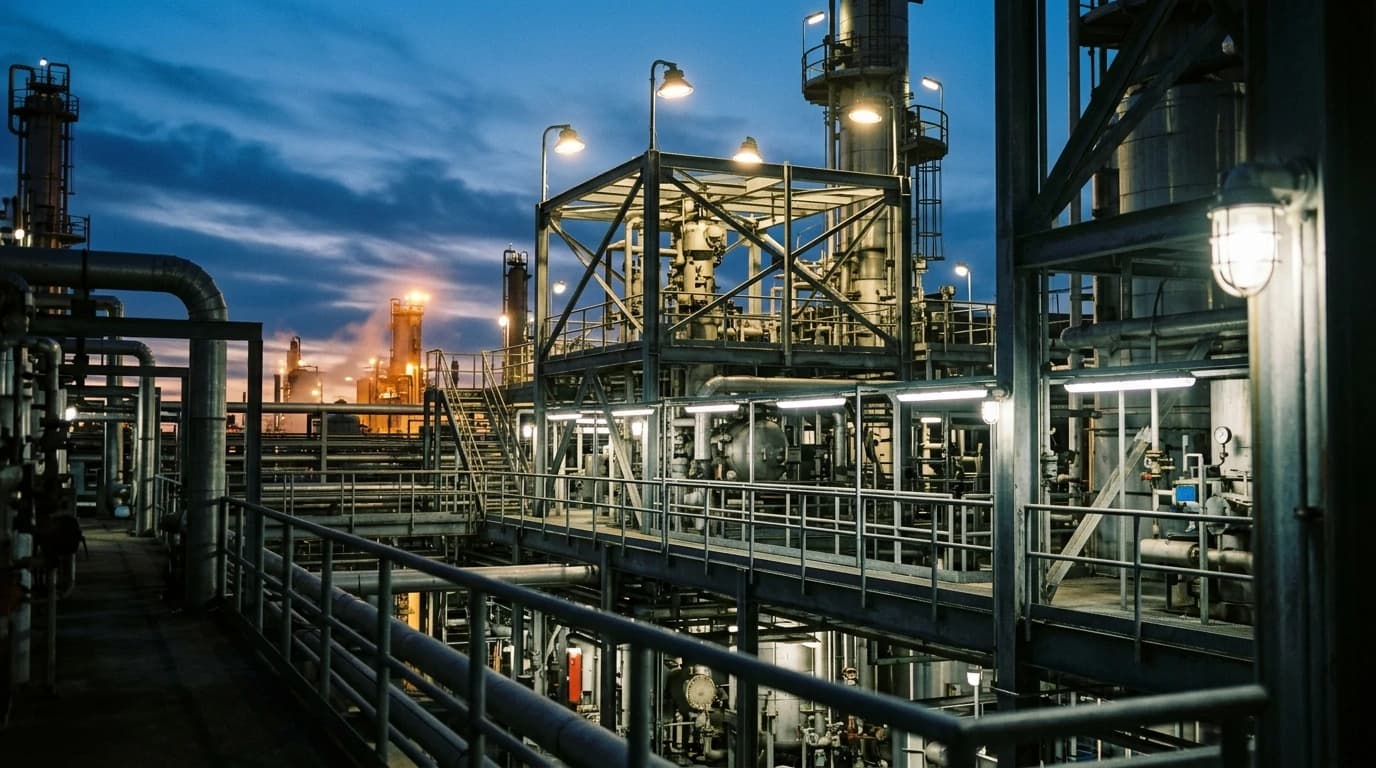
In industries where volatile gases, flammable vapors, combustible dusts, or chemical mists are present, such as oil refineries, petrochemical processing plants, chemical storage depots, offshore rigs, and paint booths. Standard commercial light fixtures pose a catastrophic fire and explosion risk. A single electrical arc, switch spark, or overheated luminaire body can ignite ambient airborne mixtures, triggering devastating industrial incidents.
This is where explosion-proof lighting (also known internationally as flameproof lighting or Ex-rated luminaires) becomes an absolute life-safety mandate. Contrary to common belief, an explosion-proof light does not necessarily prevent external explosions from happening around it; rather, it is robustly engineered so that if a volatile gas enters the luminaire and ignites internally, the heavy-duty enclosure contains the flame and cools escaping gases through precision flame paths (*flame arrestors*), preventing external atmospheric ignition.
Understanding Hazardous Area Zones (ATEX & IECEx)
Before selecting any explosion-proof fixture, facility engineers and lighting consultants must understand the hazardous zoning of the installation environment. Under the European ATEX 2014/34/EU Directive and the international IECEx system, hazardous areas are divided into distinct zones based on the frequency and duration of explosive atmospheres:
| Zone (Gas / Vapor) | Zone (Combustible Dust) | Hazard Presence Frequency | Standard Ex Protection Level |
|---|---|---|---|
| Zone 0 | Zone 20 | Continuous or for long periods (>1,000 hrs/year) | Ex ia, Ex ma (Two-fault intrinsic safety) |
| Zone 1 | Zone 21 | Likely to occur in normal operation (10-1,000 hrs/year) | Ex d (Flameproof), Ex e (Increased Safety), Ex mb |
| Zone 2 | Zone 22 | Unlikely in normal operation; short duration (<10 hrs/year) | Ex nR (Restricted Breathing), Ex ec (Increased Safety) |
“Specifying the right explosion-proof luminaire is not just a regulatory compliance check. It is the frontline defense protecting industrial human lives and multi-million dollar assets.”
Primary Types of Explosion-Proof Lights
Different industrial zones and architectural configurations require specialized optical geometries, lumen outputs, and mechanical mounting formats. Here are the primary types of explosion-proof luminaires utilized across modern hazardous facilities:
1. Flameproof LED High Bay Luminaires (Ex d / Ex tb)
Engineered for high-ceiling industrial facilities (6 meters to 25+ meters), explosion-proof high bays deliver intense luminous output (typically 12,000 to 45,000 lumens). Built with heavy-gauge, copper-free die-cast aluminum enclosures and finned thermal dissipation radiators, these fixtures illuminate expansive processing floors, oil distillation units, aircraft hangars, and chemical warehouses. They feature high-impact tempered borosilicate glass lenses that resist thermal shock and mechanical damage.
2. Hazardous Area Linear LED Battens (Ex eb mb / Ex db)
Replacing obsolete fluorescent tube fixtures, explosion-proof linear battens provide continuous, uniform, glare-free illumination along catwalks, pipe racks, industrial corridors, spray booths, and cable tray galleries. Featuring high-grade stainless steel clips, dual conduit cable entries for through-wiring, and UV-stabilized polycarbonate diffusers, they provide exceptional chemical and vibration resistance.
3. Heavy-Duty Explosion-Proof Floodlights (Ex db / Ex eb)
Designed for broad outdoor illumination, explosion-proof floodlights illuminate offshore drilling rigs, marine loading jetties, tank farms, flare stacks, and perimeter security fences. Equipped with adjustable 316-grade stainless steel trunnion brackets, specialized beam angles (narrow 15° for tower lighting to wide 120° for area wash), and marine-grade epoxy powder coatings, these luminaires withstand coastal salt fog and extreme desert sun.
4. Flameproof Well Glass & Bulkhead Fixtures
Well glass fixtures are the iconic workhorses of hazardous plants. Featuring a thick cylindrical glass dome surrounded by an electro-polished stainless steel protective wire cage, they are compact and omni-directional. Ideal for low-ceiling stairwells, boiler rooms, pump stations, and tight mechanical equipment rooms where fixtures may experience accidental bumps.
5. Explosion-Proof Emergency & Exit Luminaires
During a power outage or plant emergency shut-down, workers must quickly locate escape routes and emergency shut-off valves. Certified explosion-proof emergency luminaires feature internal high-temperature Ni-Cd or LiFePO4 battery backups providing 90 to 180 minutes of continuous autonomous operation, self-diagnostic monitoring circuits, and high-visibility illuminated ISO egress graphics.
6. Hazardous Roadway & Highway Corridor Luminaires
Industrial arterial roads passing through refinery perimeters, chemical tanker loading avenues, and port logistics routes require certified roadway luminaires with specialized Type II and Type III streetlight optical distributions, eliminating dark spots while maintaining full ATEX Zone 1 / Zone 2 certification.
7. Portable & Rechargeable Explosion-Proof Inspection Spotlights
For maintenance teams entering confined spaces, storage tanks, reaction vessels, and subterranean pipelines, ATEX Zone 0/1 certified handheld torches and rechargeable floodlights provide intrinsically safe, high-CRI portable illumination with anti-static housing polymers.
Temperature Classes (T-Ratings): Preventing Auto-Ignition
Gases and dusts have specific auto-ignition temperatures (AIT), the minimum temperature at which the mixture will combust without an external spark. Explosion-proof fixtures are classified by the maximum surface temperature their external housing can reach under full load:
- T1 (≤450°C): Suitable for gases like methane, hydrogen cyanide.
- T2 (≤300°C): Suitable for butane, propane, ethanol.
- T3 (≤200°C): Suitable for gasoline, diesel, kerosene, jet fuel.
- T4 (≤135°C): The industry standard benchmark; safe for acetaldehyde, ethyl ether.
- T5 (≤100°C) & T6 (≤85°C): Highest safety rating; required for highly volatile carbon disulfide and sulfur compounds.
In the Middle East, where ambient summer temperatures routinely touch 50°C to 55°C, luminaires must be rated with adequate thermal headroom so internal LED junction heat does not drive the fixture's exterior shell beyond its certified T-Class.
Key Engineering Checklist for UAE & GCC Projects
- Certification Verification: Ensure fixtures carry authentic IECEx / ATEX certificates from accredited notified bodies (e.g., BASEEFA, DEKRA, TÜV, UL).
- Ingress & Impact Protection: Mandate minimum IP66/IP67 ingress ratings to exclude fine Arabian desert silica sand, paired with IK08 to IK10 mechanical impact ratings.
- Corrosion Resistance: Specify copper-free aluminum (<0.1% copper) with fluorocarbon or C5-M marine-grade epoxy coatings to resist hydrogen sulfide (H2S) and coastal salt air.
- Surge Protection: Equip drivers with integrated 6kV to 10kV surge protection against grid fluctuations and lightning strikes in industrial zones.
Need certified ATEX / IECEx explosion-proof luminaires for your next project? Explore our dedicated Explosion-Proof Lights Collection or contact our industrial engineering team for DIALux calculations and hazardous area lighting designs.