Why hazardous transit corridors, refinery highways, petrochemical port tunnels, and fuel transfer routes require certified explosion-proof roadway lighting systems.
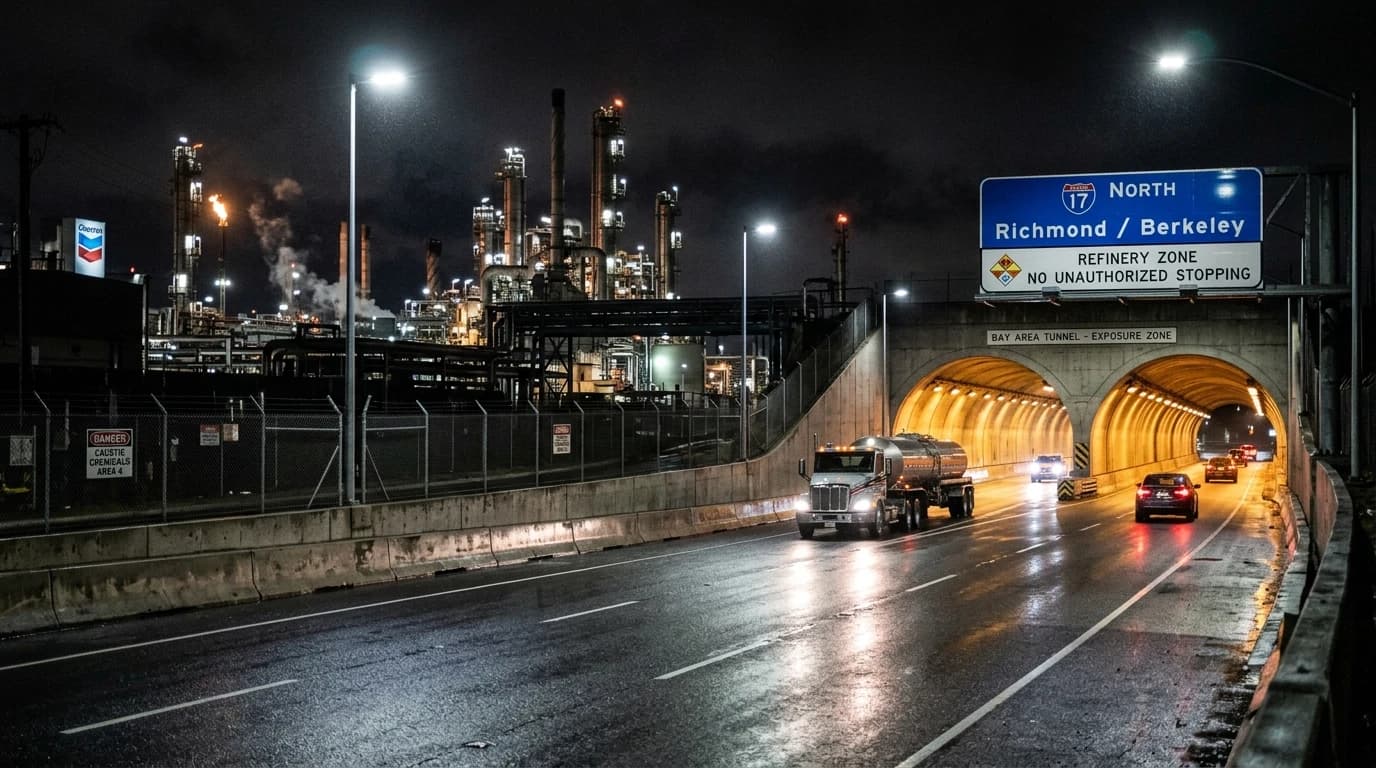
When we think about explosion-proof lighting, we usually imagine indoor oil processing units or offshore drilling platforms. However, some of the most critical and high-risk hazardous zones in modern energy-producing nations are the arterial highway corridors, tunnel underpasses, and transit routes that connect refineries, chemical processing plants, fuel bunkering ports, and LNG export terminals.
Every day, thousands of heavy tankers carrying volatile liquids (crude oil, liquefied petroleum gas, aviation kerosene, solvents) traverse dedicated industrial expressways and underpass tunnels across Dubai, Abu Dhabi, Jubail, Yanbu, and the wider GCC region. A roadside spark or electrical failure along these corridors could have catastrophic consequences. This is why specialized explosion-proof roadway and highway luminaires have become mandatory infrastructure investments.
Why Standard Highway Streetlights Fail in Hazardous Corridors
Standard municipal streetlights are engineered solely for weatherproofing (IP65) and photometric distribution. They are completely unequipped to handle hazardous industrial environments:
- No Vapor or Spark Containment: Standard aluminum cobra-head fixtures have unsealed terminal chambers. If flammable vapors from a nearby storage tank or a leaking transport trailer collect inside, an internal electrical arc will spark an external explosion.
- Vulnerability to High-Speed Pressure Waves: Heavy trucks travelling at 80-100 km/h generate significant dynamic wind-buffeting and acoustic vibration. Over time, standard brackets fatigue and electrical seals rupture.
- Thermal Runaway in Desert Climates: Standard drivers overheat when ambient roadway temperatures hit 52°C, accelerating LED lumen depreciation and causing premature driver failure.
- Lack of Chemical & H2S Resistance: Airborne sulfur fumes, acid mists, and saline coastal fog corrode standard powder coatings within months, exposing bare metal to oxidation.
“Infrastructure lighting in hazardous corridors must achieve two simultaneous objectives: zero ignition risk under explosive atmospheres, and flawless optical clarity for high-speed highway motorists.”
Critical Engineering Requirements for Hazardous Roadway & Tunnel Luminaires
1. Dual Compliance: CIE 88 Roadway Standards & ATEX / IECEx Certification
Roadway explosion-proof luminaires must meet international road lighting standards (such as CIE 115 / CIE 88 for tunnels and M1-M3 roadway classifications), delivering average luminance ($L_{avg} \ge 1.5 - 2.0\text{ cd/m}^2$) and exceptional longitudinal uniformity ($U_o \ge 0.40$). Simultaneously, they must carry certified ATEX Zone 1 / Zone 2 (or Class I, Div 2) approvals with Ex db or Ex ec flameproof / increased safety ratings.
2. Glare-Free Asymmetric Batwing Optics
Driver safety on high-speed industrial highways depends on avoiding disabling glare (Threshold Increment $TI < 10\%$). Explosion-proof highway luminaires incorporate precision optical lenses with sharp beam cutoffs that throw light down and across multiple highway lanes without blinding oncoming motorists or casting stray light toward surrounding processing towers.
3. Extreme Mechanical Resilience (IK10 & Dynamic Wind Loading)
Fixtures installed on 10m-14m roadway poles or tunnel ceilings must withstand severe vibrations, gravel strikes, and wind gusts exceeding 160 km/h. They feature heavy-duty die-cast copper-free aluminum enclosures, 8mm thick tempered safety glass, and 316 stainless steel mounting hardware rated at IK10 mechanical impact resistance.
4. Intelligent Tunnel Lighting & Adaptive Dimming
In tunnel entrance zones (the *threshold zone*), drivers experience the 'black hole effect' where bright daylight blinds their transition into a dark tunnel. Explosion-proof tunnel luminaires integrate DALI-2 and 0-10V control protocols connected to luminance photometers outside the portal, automatically ramping up to full intensity during noon sunlight and smoothly dimming at night to maintain optimal visual adaptation.
Standard Highway Lights vs. Explosion-Proof Highway Luminaires
| Feature | Standard Municipal Streetlight | Explosion-Proof Highway Luminaire |
|---|---|---|
| Hazardous Classification | Non-Hazardous only | ATEX Zone 1 / 2, IECEx, Class I Div 2 |
| Enclosure Material | Standard Die-Cast Aluminum | Copper-Free Marine Grade Aluminum (<0.1% Cu) |
| Lens Protection | Acrylic / Thin Glass (IK07) | Tempered Borosilicate Glass (IK10) |
| Gas / Dust Tightness | IP65 Weatherproof | IP66 / IP67 / IP68 Flameproof Sealed |
| Max Operating Ambient | 40°C - 45°C | 55°C - 60°C continuous Gulf rating |
| Surge Protection | 4kV Standard | 10kV / 20kV Industrial Grade |
Turnkey Implementation Across Middle East Infrastructure
Credence Lighting works directly with highway authorities, industrial master developers, EPC contractors, and national oil companies across the UAE, Saudi Arabia, and Bahrain. From initial DIALux roadway luminance calculations and hazardous classification audits to certified luminaire supply and pole-foundation structural analysis, our engineering team ensures uncompromised safety.
Planning a hazardous corridor, tunnel underpass, or refinery transit lighting upgrade? Contact Credence Lighting's infrastructure specialists today or explore our complete Explosion-Proof Lighting Range.